Leading Manufacturer of Lithium Battery Chargers and Power Adapters
+86-15361625091
+8615361625091

Views: 0 Author: Site Editor Publish Time: 2025-12-19 Origin: Site


Have you ever encountered these situations: the electric vehicle charger was temporarily replaced by another one, and the battery bulged soon after; or you used an outdoor power supply charger to charge the lithium battery, but it was not only slow, but the equipment was also abnormally hot?
Behind this is a common misunderstanding: thinking that the same output voltage can be used universally. In fact, lead-acid, lithium-ion, and lithium iron phosphate batteries have completely different chemical characteristics and require completely different "charging recipes". Choosing the wrong charger will directly damage the health and safety of the battery.
This guide will clearly analyze the core differences between the three types of chargers and provide you with an actionable purchasing method in 2025.
1. Core principle: Why can’t chargers be mixed?
The core task of the charger is to replenish the battery with appropriate "rhythm" and "dose". This rhythm is the charging algorithm.
1. Lead-acid battery charger: requires “patient maintenance”· Correct method: Three-stage charging of constant current-constant voltage-float charging must be used. The final "float charge" stage uses a small current to offset self-discharge, which is crucial to prevent battery sulfation and extend life.
· Risk of mixed use: If you use a charger without float charging or with a rough algorithm, the battery will lose power for a long time and its capacity will decrease sharply. If misused for lithium batteries, overcharging may occur.
2. Lithium-ion battery charger: pay attention to "precise stop"
· Correct method: Use constant current-constant voltage two-stage charging. It must stop immediately after reaching the cut-off voltage of 4.2V/section.
· Mixed use risk: If a lead-acid charger is used, continued float charging will cause the lithium battery to bulge, posing a safety hazard.
3. Lithium iron phosphate battery charger: requires "extreme precision"
· Correct method: It is also two stages, but its cut-off voltage is 3.65V/section, and the voltage accuracy is extremely high (the error usually needs to be within ±1%).
· Risk of mixed use: Using ordinary lithium battery chargers (4.2V/cell) will cause serious overcharging and severely damage the battery cells.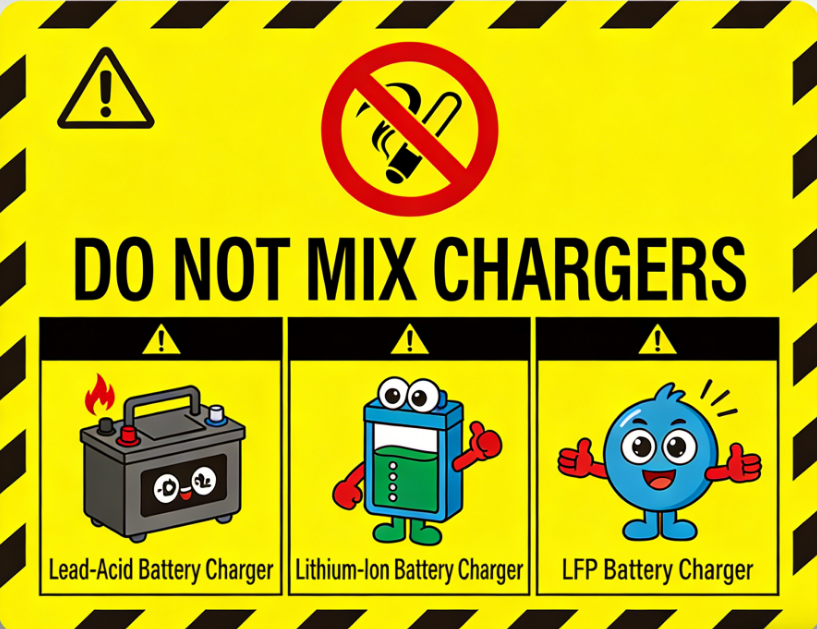
Key conclusion: Charging algorithm and cut-off voltage are fundamental differences and must not be mixed
2. The key to purchasing: understand the two parameters
Without complicated knowledge, most risks can be avoided by grasping the following two points:
1. Voltage: Must match absolutely · System voltage: Is the battery 12V, 24V or 48V? The charger output voltage must be consistent with this.
2. Current: determines charging speed and health · Simple formula: charging current (A) ≈ battery capacity (Ah) × (0.2 ~ 0.5). · For example: For a 20Ah electric vehicle lead-acid battery, it is ideal to choose a 4A to 10A charger.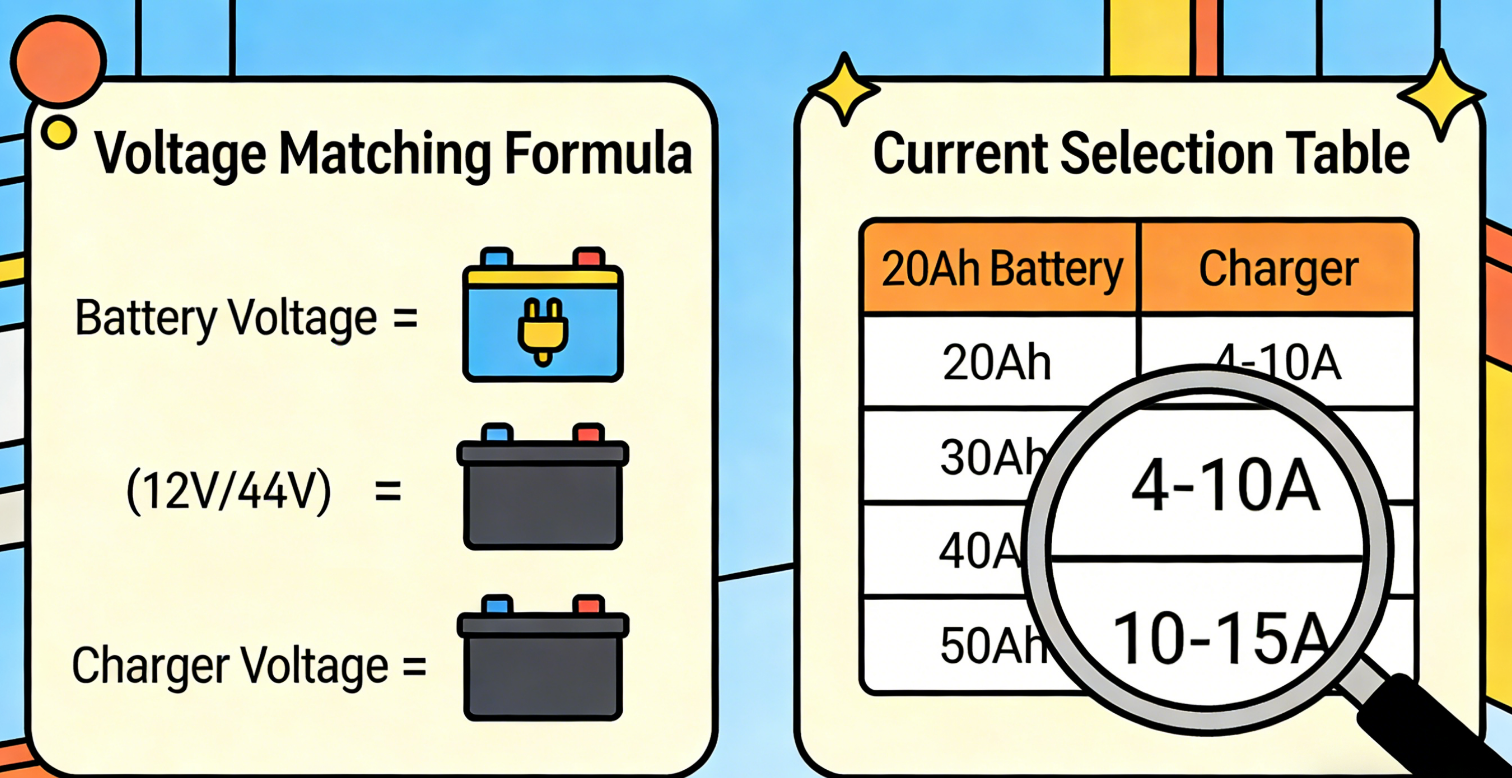
3. Security bottom line: authentication and protection functions
Safety is a non-negotiable red line. Please be sure to confirm when purchasing:
· Safety certification: Basic certification (required): The product should be clearly printed with UL (North America), CE (European Union), PSE (Japan) and other mandatory safety certification marks for the sales area. Uncertified products equal unknown risks.
· Protection function: must include multiple protections such as overcharge, overtemperature, short circuit, reverse connection, etc.
4. Solution: Matching suggestions for three types of batteries
With the core principles understood, we can translate these key points into actionable purchasing strategies.
1. Lead-acid battery (for electric vehicles, emergency power supply
· Technical specifications: The device features three-phase charging capability; current selection is based on 0.2C-0.5C capacity; aluminum casing with superior heat dissipation is recommended.
Reference design: For instance, Lilon's lead-acid charger exemplifies this approach. Its algorithm specifically targets sulfurization delay while ·incorporating multiple safeguards, making it a benchmark solution that meets the specified technical requirements.
2. Lithium-ion batteries (for drones and energy storage systems)
· Technical points: Confirm that the cut-off voltage is 4.2V/section, which must match the electrical specifications of the corresponding equipment.
3.Lithium iron phosphate batteries (for outdoor power supply and household energy storage)
·Technical points: Voltage accuracy is the core and needs to strictly match 3.65V/section; choose products clearly marked "Special for lithium iron phosphate".
· Solution reference: This type of battery has the highest requirements on chargers, and products with clear technical specifications need to be selected. For example, Lilon's special lithium iron phosphate model is marked with extremely high voltage accuracy in technical parameters, and has enhanced temperature control and protection, which can be used as a technical benchmark model in high-demand scenarios.
5. Charging habits to extend battery life
1. Ventilated charging: Make sure the charging environment has good heat dissipation.
2. Avoid over-discharge: Lead-acid batteries can be recharged when their power is below 30%; lithium/iron lithium batteries should be kept within the 20%-80% power range.
3. Regular maintenance: Clean the charging interface to prevent oxidation.
4. Long-term storage: Store the battery with half power and unplug the charger from the power source.
epilogue, peroration
Choosing a charger for a battery is essentially matching it with a qualified "energy steward." The core lies in accurately understanding battery requirements (voltage, algorithm) and adhering to the bottom line of safety (certification, protection). No matter which brand you choose, you should return to the technical parameters and safety specifications of the product itself. A correct match is the most effective investment in equipment life.
This guide is designed to help you make informed decisions. If you could share your battery model, I can recommend the right charger specifications for you.


