Leading Manufacturer of Lithium Battery Chargers and Power Adapters
+86-15361625091

Views: 26 Author: Lilon Publish Time: 2026-11-03 Origin: Site


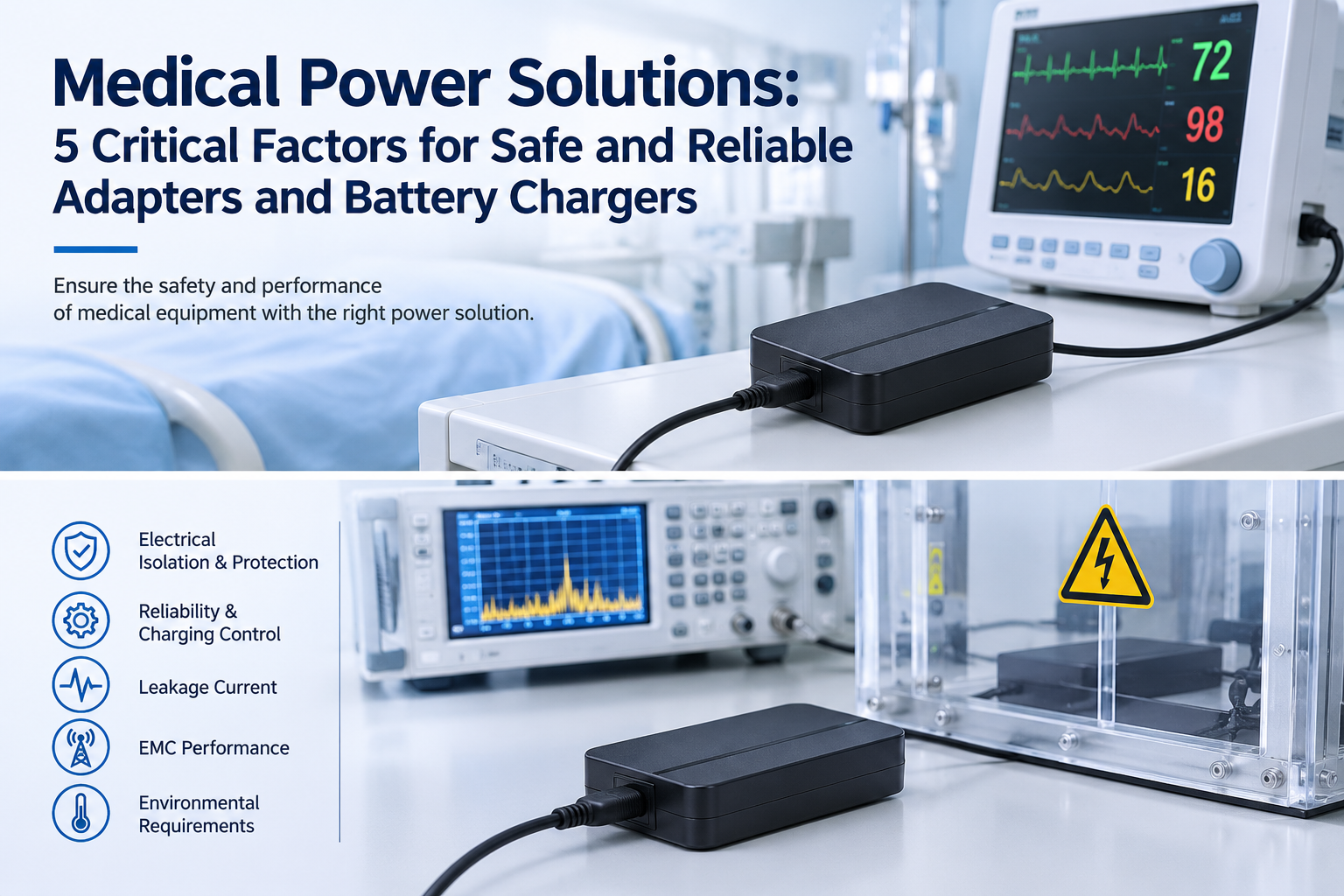
Medical equipment depends on stable and reliable power to perform its intended functions. Whether a device operates directly from an AC/DC power adapter or uses a rechargeable battery, the external power solution plays an important role in its overall safety and performance.
However, medical power requirements involve more than matching output voltage and current. Electrical isolation, leakage current, reliability, electromagnetic compatibility (EMC), and operating conditions all need to be considered.
Two common external power solutions are AC/DC power adapters and battery chargers. Although they may look similar, they serve different purposes:
AC/DC power adapters convert AC mains power into regulated DC power to operate electronic equipment.
Battery chargers deliver controlled electrical energy to recharge batteries according to their chemistry and charging requirements.
Understanding the differences between these products, as well as the following five design considerations, can help medical equipment manufacturers make better power supply decisions.
Electrical isolation is one of the most important considerations in medical power design.
An external AC/DC adapter separates its high-voltage AC input from its low-voltage DC output. This isolation helps reduce the risk of hazardous voltage reaching the powered equipment or users.
For medical applications, the required level of protection depends on the equipment's intended use, construction, and patient connections.
Two important concepts in IEC 60601-1 are:
MOOP (Means of Operator Protection): Protection against electrical hazards for operators.
MOPP (Means of Patient Protection): Protection against electrical hazards for patients.
These protection measures may involve insulation systems, creepage distances, clearance distances, and dielectric strength.
Battery chargers also require careful consideration of electrical isolation. A charger may be connected to an external power source while its output is connected to a rechargeable battery inside or associated with medical equipment.
The safety assessment needs to consider the complete charging arrangement, including whether the patient can remain connected to the equipment during charging.
The required protection level should therefore be determined from the medical device's architecture and risk assessment, rather than assuming that every adapter or charger requires the same isolation specification.
Medical equipment may be used for continuous monitoring, testing, or other important functions. An interruption in power can affect equipment availability and operation.
For AC/DC adapters, important considerations include:
Stable output voltage under the expected load.
Sufficient current and power capacity.
Appropriate overvoltage and overcurrent protection.
Short-circuit protection.
Thermal performance and long-term reliability.
Battery chargers have additional requirements because they must manage the charging process.
A suitable charger needs to match the battery chemistry, nominal voltage, capacity, and manufacturer's charging specifications. Depending on the battery type, charging may involve specific current and voltage control stages.
For example, lithium-ion battery packs commonly use a controlled charging profile. However, the exact voltage limits, current levels, and termination conditions depend on the cell configuration and battery management system (BMS).
Important charger considerations include:
Correct charging voltage and current.
An appropriate charging profile for the battery chemistry.
Protection against abnormal charging conditions.
Compatibility with the battery pack and its BMS.
Suitable temperature and operating limits.
An adapter and a battery charger should not be treated as interchangeable products. An adapter supplies DC power to equipment, while a charger must also meet the battery's charging requirements.
Leakage current is unwanted electrical current that can flow through insulation, parasitic capacitance, or other unintended paths.
In external AC/DC adapters, leakage current can be influenced by the insulation design and components used in EMI filtering, including Y capacitors.
For medical applications, leakage current is particularly important because some medical equipment has conductive connections to the patient's body.
The applicable safety limits depend on factors such as equipment classification, applied-part type, protection measures, and the configuration of the complete medical electrical system.
Battery chargers introduce another aspect to consider: the electrical relationship between the charger, battery pack, and medical equipment during charging.
For example, if a patient remains connected to monitoring equipment while its battery is being charged, the charging arrangement must be evaluated as part of the overall electrical safety design.
Therefore, leakage current should be assessed in the intended operating modes, including normal operation and relevant single-fault conditions.
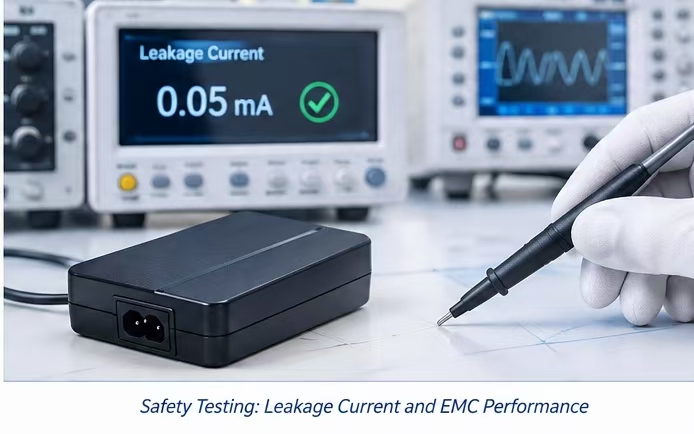
Medical equipment often contains sensitive electronic circuits for monitoring, measurement, communication, and data processing.
Both AC/DC adapters and battery chargers can generate electromagnetic disturbances if their designs and filtering are inadequate.
There are two main aspects of EMC:
Emissions: Electrical noise generated by the adapter or charger should not cause unacceptable interference with nearby equipment.
Immunity: The power solution and the medical equipment should maintain their intended operation when exposed to electromagnetic disturbances.
For example, switching circuits inside an adapter or charger can generate conducted and radiated noise. If not properly controlled, this noise may affect sensitive measurement or communication circuits.
IEC 60601-1-2 addresses electromagnetic compatibility for medical electrical equipment and systems. EMC performance should be considered in the context of the final equipment configuration, not simply based on the power supply component alone.
Medical equipment is used in different environments, including hospitals, clinics, laboratories, and homes.
The operating environment can affect the performance and reliability of both adapters and battery chargers.
Important factors include:
Temperature: High ambient temperatures can affect component life and thermal performance.
Humidity: Moisture can increase electrical risks and affect insulation.
Ventilation: Limited airflow may increase operating temperatures.
Input power conditions: Variations in mains voltage and electrical disturbances can affect operation.
Mechanical handling: Portable equipment and external power accessories may experience repeated connection, disconnection, and movement.
Home healthcare applications can require additional attention because equipment may be operated by patients or caregivers in less controlled environments.
For battery chargers, the charging environment also matters. Charging temperature limits and ventilation requirements should follow the battery and charger specifications.
A power solution suitable for a controlled clinical environment should not automatically be assumed suitable for every home-use or portable medical application.
Although adapters and chargers share several safety considerations, their technical selection requirements are not identical.
| Selection factor | AC/DC power adapter | Battery charger |
|---|---|---|
| Main function | Supplies DC power to equipment | Recharges a battery |
| Output requirements | Voltage, current, and power | Charging voltage, current, and profile |
| Electrical isolation | Based on system protection requirements | Based on charging architecture and system protection requirements |
| Leakage current | Evaluate in the intended equipment configuration | Evaluate during relevant charging and operating modes |
| Protection | Overvoltage, overcurrent, short circuit, and thermal protection as required | Charging-related protections and battery/BMS coordination |
| Compatibility | Voltage, current, connector, and polarity | Battery chemistry, voltage, capacity, connector, and charging requirements |
| EMC | Evaluate with the powered equipment | Evaluate with the charger and connected equipment |
The selection process should begin with the medical equipment's electrical specifications and intended use.
For an adapter, manufacturers should confirm the required DC output, power capacity, connector, polarity, and system protection requirements.
For a battery charger, they should additionally confirm battery chemistry, charging voltage, current, charging profile, and compatibility with the battery management system where applicable.
Both products should be assessed in the context of the final equipment configuration.
IEC 60601-1 establishes general requirements for the basic safety and essential performance of medical electrical equipment and medical electrical systems.
It is an important reference when evaluating power arrangements used in medical applications. However, it does not mean that every external adapter or battery charger automatically needs to obtain a separate IEC 60601-1 certificate.
The applicable requirements depend on the product's intended use, its role in the medical electrical system, the equipment architecture, and the relevant regulatory framework.
For home healthcare equipment, IEC 60601-1-11 may also be relevant. EMC requirements for medical electrical equipment and systems are addressed separately in IEC 60601-1-2.
A power adapter or charger should therefore be evaluated according to the final application. Component-level specifications and test reports alone do not automatically establish compliance of the complete medical device.
External AC/DC adapters and battery chargers are both important parts of medical equipment power systems, but they perform different functions and have different technical requirements.
Adapters need to provide suitable DC power for equipment operation, while battery chargers must also manage the charging process according to battery specifications.
For both product types, electrical isolation, leakage current, reliability, EMC, and environmental conditions are important considerations.
By evaluating these factors early in the design and supplier-selection process, medical equipment manufacturers can make more informed decisions about their external power solutions.


