Leading Manufacturer of Lithium Battery Chargers and Power Adapters
+86-15361625091
+8615361625091

Views: 0 Author: Site Editor Publish Time: 2026-01-06 Origin: Site


When choosing a charger for your eBike, have you ever made the mistake of "looking at the power but not the voltage"? You obviously bought a high-power charger, but the more you charge it, the shorter the battery life becomes, and the battery may even become bulging or unable to charge? In fact, the core adaptation key of eBike charger is not power, but voltage matching. The three main voltage models, 36V, 48V, and 60V, have completely different purchasing logic for the corresponding exclusive chargers. Choosing the wrong charger will not only damage the battery, but may also cause safety hazards. Today I will teach you how to choose the right charger according to the voltage, so that the battery can last 2-3 years longer.
1.First, understand: Why is it that no matter how expensive the charger is, it's useless if the voltage is incorrect?
The lithium battery of eBike is a "precision device" and has strict requirements on charging voltage - if the voltage is too low, it will not be fully charged, and if the voltage is too high, the battery core will be burned directly. For example, the full voltage of a 36V battery is 42V, a 48V battery is 54.6V, and a 60V battery is 72V. If you use a 60V charger to charge a 36V battery, it is equivalent to "overvoltage feeding", which may cause the battery to bulge after 1-2 times. On the contrary, if you use a 36V charger to charge a 60V battery, it will never be fully charged, and it will also keep the battery in a "hungry state" for a long time and accelerate its decay.
More critically, eBikes with different voltages require distinct battery management system (BMS) protection logic. A dedicated charger must precisely match the BMS to execute the scientific charging process: constant current fast charging, constant voltage replenishment, and power cut upon full charge. In contrast, a universal charger cannot adapt to varying BMS protocols, which is the root cause of why universal chargers often damage batteries.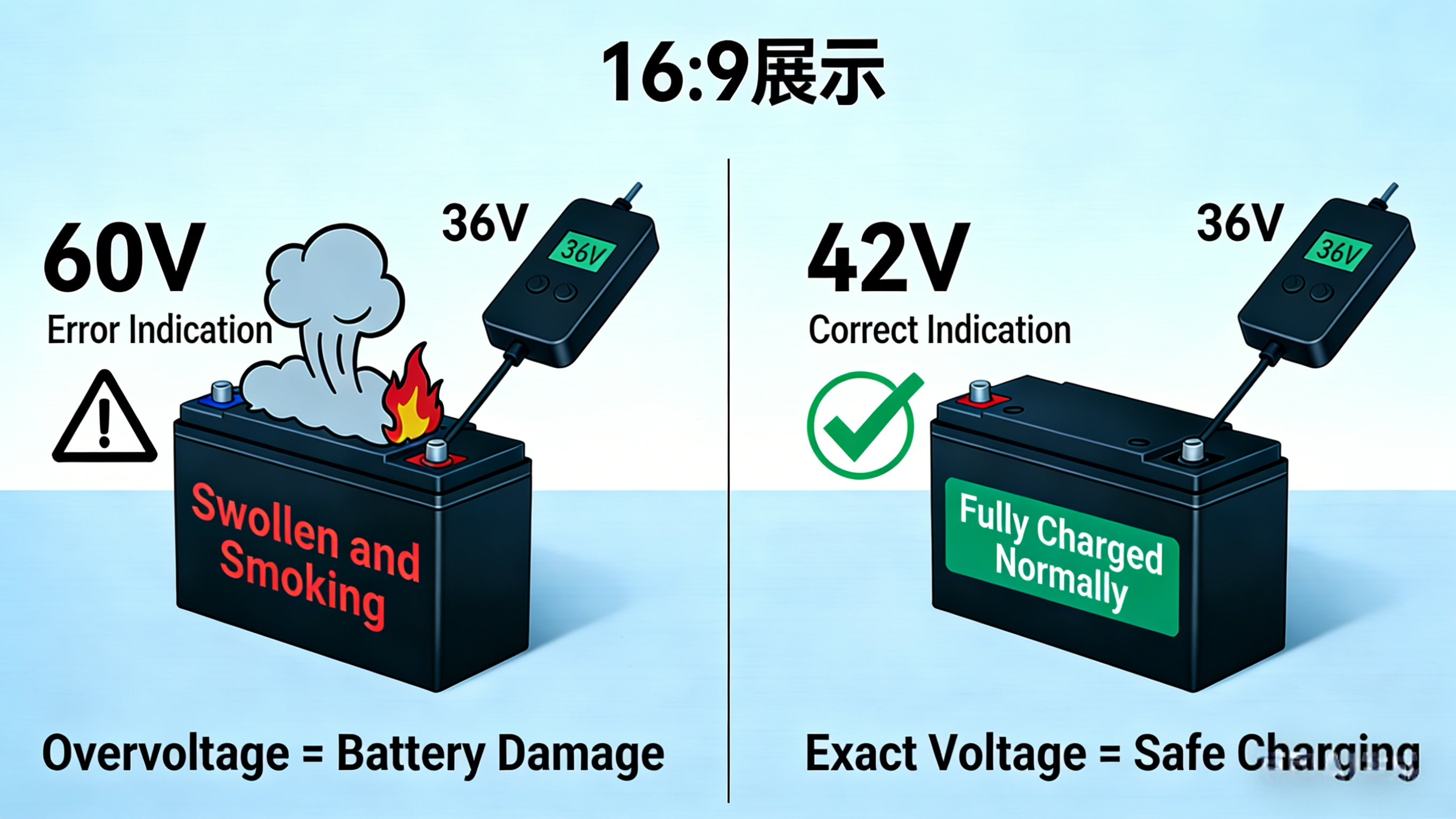
2. Voltage selection guide: 36V/48V/60V models, each has its own "charging password"
1. 36V eBike: Focus on short-distance commuting, choose "low power + high adaptability" exclusive charger
Applicable scenarios:
Commonly found in small electric scooters and short-distance commuting eBikes (30-50km range), such as Segway E2 Pro, Segway F3, etc., the battery capacity is mostly 10Ah-14Ah. This type of vehicle does not have high requirements for charging speed, but has extremely high requirements for "adaptation accuracy".
Key points for purchasing exclusive chargers:
Voltage parameters: Look for "output voltage 42V". The standard full-charge voltage of a 36V battery is 42V. The output voltage of the exclusive charger must be accurately controlled between 41.8V-42.2V (accuracy within ±0.2V). Avoid buying products marked "36V-48V universal". Excessive voltage fluctuations can easily damage the battery core.
Select 1.5A-3A for current: it is enough to avoid waste. For 10Ah battery, choose 1.5A (63W). For 14Ah battery, choose 3A (126W). Excessive current will cause small-capacity batteries to heat up. For example, if you use a 3A charger to charge a 10Ah battery, it can be fully charged in 1.5 hours, which is just right.
Must-read: 'Interface Compatibility' – Don't Overlook Minor Details. Most 36V models use compact connectors (e.g., DC round-head or pinhead). Always verify the original charger's interface type when purchasing. For example, the Segway E2 Pro requires a dedicated DC connector, while the Segway F3 uses a pinhead. Loose connections can cause poor charging contact and may damage the battery interface over time.
Warning to avoid pitfalls:
Beware of '36V Universal Fast Charging'! Many low-cost universal chargers advertise '36V fast charging,' but their actual output voltage reaches 45V. While it appears to charge faster, this is actually over-voltage charging, which can reduce battery life by 30% in just three months.
1.48V eBike: Main commuting model, select "Medium Power + BMS-compatible" dedicated charger
Applicable scenarios:
Covering 80% of household commuting eBikes (with a range of 50-80km), such as Velotric Discover 1, Segway MAX G3, AOVO electric scooters, etc., their battery capacities are mostly 12Ah-20Ah, which is the most common voltage type. This type of vehicle requires both fast charging efficiency and battery safety, so the dedicated charger must balance "power" and "intelligent protection".
Key points for purchasing a dedicated charger:
Voltage accuracy: The standard full-charge voltage of a 48V battery locked at "output voltage 54.6V" is 54.6V. The voltage error of a dedicated charger needs to be ≤±0.1V. For example, products marked "54.5V-54.7V" are safer than general charging with an error of ±0.5V and can avoid overcharging of the battery cells.
Select the charger current based on battery capacity: 3A for 12Ah batteries and 5A for 20Ah batteries. The optimal charging current (A) is calculated as (Ah) × 1.2. For example, a 12Ah battery requires 3A (162W) for 4 hours to fully charge, while a 20Ah battery needs 5A (270W) for 3.5 hours. Avoid chargers exceeding 6A, as this may raise the battery temperature above 45°C and accelerate aging.
We used the same 48V20Ah eBike for testing. The difference between the Lilon charger and the universal charger is obvious:
| test items | 48VLilon charger | 48V universal charger |
| Time to full charge | 3.5 hours | 2.8 hours |
| Battery life decreases after 1 month | 3% | 15% |
| Battery temperature during charging | 38℃ | 52℃ |
| Battery cycle life | 300+ times | 150+ times |
3. 60V eBike: long-lasting model, choose "high power + temperature control protection" exclusive charger
applicable scene :
They are more common in long-range electric motorcycles and cargo eBikes (range 80-120km), such as Energica Motor Company's models, Aixam Moto electric motorcycles, etc. The battery capacity is mostly 20Ah-30Ah, which requires a high-power charger to meet fast charging needs, but the safety risk is also higher.
Key points for purchasing exclusive chargers:
The voltage must be accurate "72V". The full voltage of the 60V battery is 72V. The output voltage of the exclusive charger must be stable at 71.8V-72.2V, and must support "three-stage charging" (constant current-constant voltage-trickle) to avoid large currents directly impacting the battery.
The current is 5A-8A, with "intelligent temperature control" the 20Ah battery is 5A (360W), the 30Ah battery is 8A (576W), but it must have a temperature control sensor - when the charger temperature exceeds 45°C or the battery temperature exceeds 50°C, it will automatically reduce the current to 3A to prevent overheating and fire.
Notice:
60V models must never use 48V or 36V chargers! A large voltage difference will cause the charger to instantly overload and burn out, and may even cause a short circuit in the battery
3.Three universal tricks to avoid pitfalls regardless of voltage
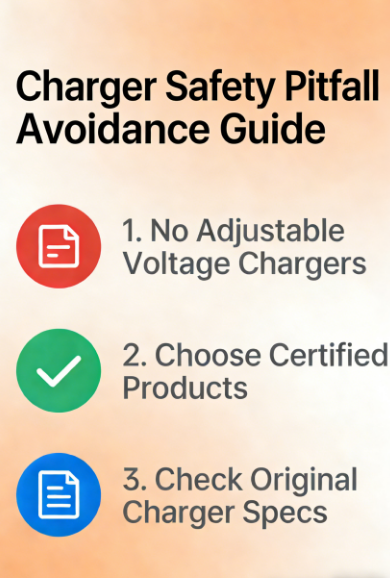
1.Avoid universal chargers labeled 'voltage adjustable'. Many sellers advertise '36V/48V/60V adjustable', but these chargers have poor voltage regulation accuracy (±1V or more) and cannot support BMS protocols for different voltages. Essentially, they are still 'universal chargers' that will inevitably damage your battery with prolonged use.
2. Check the "certification mark" and reject three-no products. Formal exclusive chargers have national certification (the outer casing is marked with "CE UL, etc." mark). Products without certification may cut corners. For example, there is no overvoltage protection, which may cause the risk of "explosion" during charging.
3. Keep the parameters of the original car charger and choose the voltage of the vehicle according to the "original standard". When you are not sure about the vehicle voltage, look at the "output parameters" of the original car charger - for example, if it is marked "output 42V 2A", choose a dedicated charger with 42V voltage and 2A-3A current. Choose according to the original standard and you will never go wrong.
4. Summary: Choosing the right charger is equivalent to "buying insurance" for the battery
For 36V, choose "42V low power + strict interface", for 48V, choose "54.6V medium power + BMS adaptation", and for 60V, choose "72V high power + temperature control protection" - choosing the right one according to the voltage is the core logic of choosing an exclusive charger. Stop trying to buy a universal charger at a cheap price. An eBike battery can cost as little as a few hundred yuan or as much as a thousand yuan. Choosing the right dedicated charger can not only extend the battery life by 2 times, but also avoid safety accidents caused by charging problems.
If you are still not sure which eBike charger to choose? You can leave yours (such as "Segway MAX G3 interface type") or the original car charger parameters (such as "output 54.6V 3A"), and we will recommend an accurately adapted exclusive charger for you!


