Leading Manufacturer of Lithium Battery Chargers and Power Adapters
+86-15361625091

Views: 26 Author: Lilon Publish Time: 2026-11-07 Origin: Site


Short answer: the battery is not the only part that changes. A lead-acid charger and a lithium charger look similar and often share a voltage label, but they are built to two different jobs. Swap the battery and keep the charger, and the best case is a pack that never charges properly; the worst case is a pack that is quietly overcharged every night.
This comes up constantly in wheelchair, mobility scooter and golf cart conversions — usually because the old charger still has the right plug on it. Here are the four differences that make it unusable, and how to check each one.
| System | Lead-acid charger | Lithium charger | Gap |
|---|---|---|---|
| 24 V | absorption ≈ 28.8–29.4 V, float ≈ 27–27.6 V | 29.4 V, then stop | Small on paper, wrong in practice |
| 36 V | absorption ≈ 43.2–44.1 V, float ≈ 40.5–41.4 V | 42.0 V, then stop | 1–2 V above lithium full charge |
| 48 V | absorption ≈ 57.6–59.2 V, float ≈ 54–55 V | 54.6 V, then stop | 3–5 V above lithium full charge |
| 60 V | absorption ≈ 72–73.5 V, float ≈ 67.5–69 V | 67.2 V, then stop | 5–6 V above lithium full charge |
Look at the 48 V and 60 V rows: the lead-acid charger's absorption voltage sits above the lithium pack's full-charge voltage. That is the whole problem in one line.
"48V" describes the pack, not the charger. A 48 V lead-acid pack is 24 cells at 2 V each; to charge it fully the charger has to push to roughly 57.6–59.2 V. A 48 V lithium pack is 13 cells at 4.2 V, and 54.6 V is as high as it may ever go.
So the old charger is not "close enough". It is designed to hold a voltage the lithium pack cannot accept. Whether that turns into a blocked charge or an overcharge depends entirely on whether the BMS reacts in time — and you do not want to find out which one you have.
A lead-acid charger works in three stages: constant current, then absorption, then float — a lower voltage held indefinitely to keep the battery topped up. That is correct for lead-acid, which likes being held at float and loses capacity if left flat.
Lithium works the other way. It charges at constant current, holds constant voltage at the top, and then stops. There is no float stage, because holding a lithium pack at full voltage continuously is exactly what shortens its life.
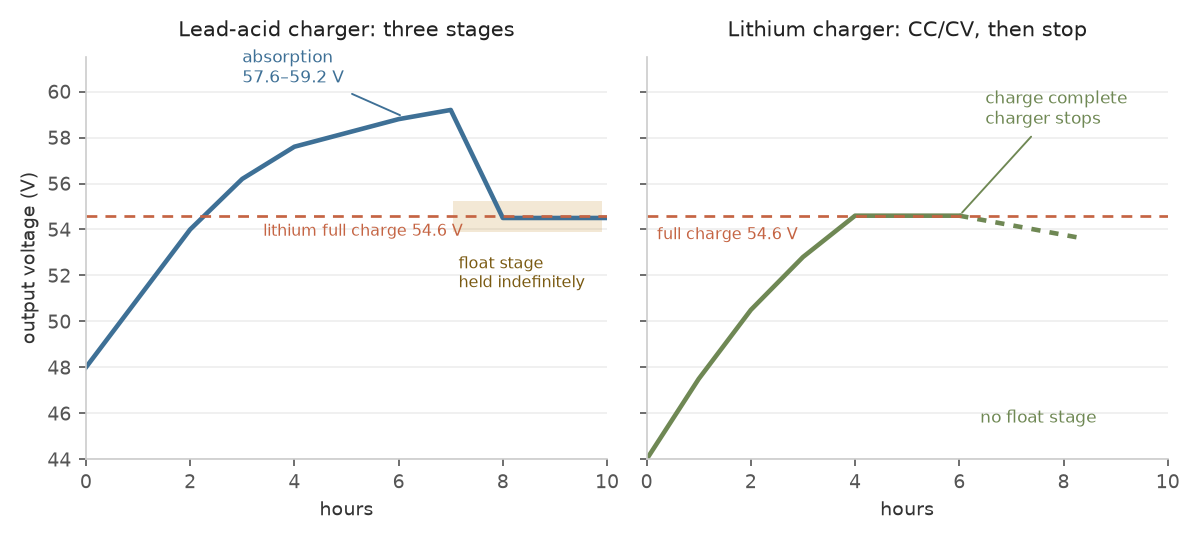
Connect a lead-acid charger to a lithium pack and it will do what it was built to do: reach absorption, then sit there. The pack is left at a voltage it should only see for minutes, for hours at a time.
This is the part people miss. A lead-acid charger never really disconnects — it keeps a small current flowing to maintain the battery. On a lithium pack, that same behaviour means the cells stay pressed against their upper limit, and the balancing circuit keeps working with no rest.
Some lead-acid chargers also run equalisation or desulphation modes — deliberate over-voltage pulses to break up sulphation on old plates. On a lithium pack, those pulses are simply over-voltage events, repeated on a schedule the battery never agreed to.
A lithium charger ends the charge and goes quiet. That quiet is a feature.
Lead-acid tolerates charging in the cold, just more slowly. Lithium does not: charging below 0 °C causes lithium plating on the anode, and that damage is permanent — it does not recover when the battery warms up.
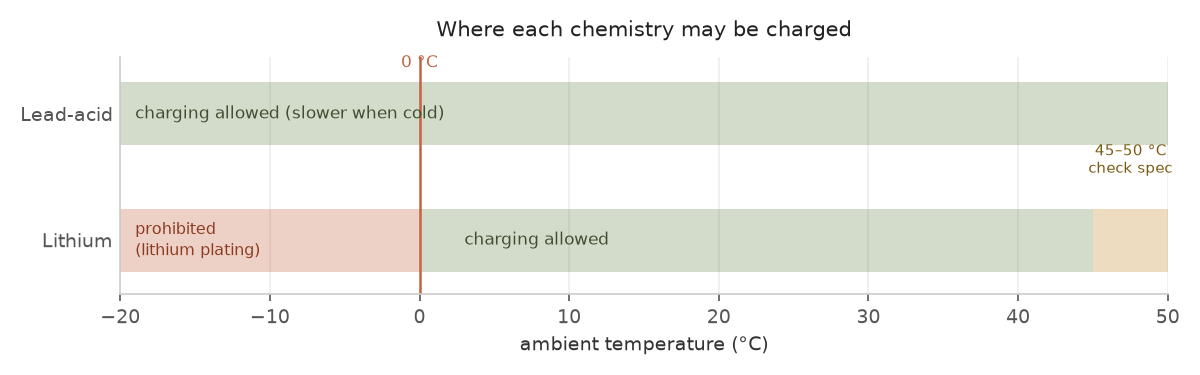
This matters more for mobility equipment than for almost any other product, because wheelchairs and scooters live in garages, sheds and porches. A user who charges overnight in an unheated garage in winter is doing something the old lead-acid pack tolerated and the new lithium pack cannot.
Good lithium chargers and BMS units include a temperature cut-off, typically refusing to charge below 0 °C and above roughly 45 °C. If your charger has no temperature sensing and no NTC input, that protection has to live in the battery — confirm it does before relying on it.
Read the battery label: nominal voltage, chemistry, and the stated charge voltage. That last number is the one the charger must match.
Measure the old charger's output with a meter. If it reads several volts above the new pack's full-charge voltage, it is not usable.
Confirm the new pack's BMS has over-voltage and low-temperature cut-off. Ask for it in writing; most datasheets state both.
Check the connector and polarity — conversions often reuse the old port, and polarity is not standardised.
Decide the charge location. If it is an unheated space, the low-temperature cut-off is not optional.
If any of the five fails, the charger changes with the battery. That is the whole rule.
Voltage: 48 V lithium pack → 54.6 V charger. 60 V pack → 67.2 V. 24 V pack → 29.4 V.
Current: typically 0.3–0.5C. A 20Ah pack takes 6–10 A comfortably; a small 8Ah pack does not.
End of charge: the charger must stop, not float.
Temperature: sensing and cut-off, or a BMS that enforces it.
Connector: matched to the port, with correct polarity.
Lilon builds chargers in these voltages — 29.4 V for 24 V mobility systems, 42 V, 54.6 V and 67.2 V among them — so a conversion is a specification match rather than a workaround. The useful question for any supplier is not "does it fit", but "what is the end-of-charge behaviour and what happens at 0 °C".
The rules do not change with the vehicle, but the numbers do. Golf carts are commonly 48 V systems with larger packs, so the charger is usually a higher-current unit — and the float behaviour of the old lead-acid charger is the same trap. An RV conversion adds a second complication: the pack may be charged from a vehicle alternator or a solar controller as well as from mains, and each of those sources has its own voltage window.
In both cases the check is identical: the charger's end-of-charge behaviour, its voltage setpoint, and what happens at low temperature.
Not on a lithium pack. A single session can push the cells past their limit if the BMS is slow or absent. Wait for the correct charger.
No. The labels describe the pack. What matters is the charger's output voltage versus the pack's full-charge voltage — often 57.6–59.2 V versus 54.6 V.
Not necessarily — lithium to lithium with the same cell count and voltage can often keep the charger. Changing chemistry is the line that matters.
It is an over-voltage pulse mode meant for lead plates. Do not run it into a lithium pack under any circumstances.
Ask for the BMS specification sheet. A pack with charging cut-off below 0 °C will state it; if the datasheet is silent, assume it is absent.
It will undercharge it — no absorption stage, no float — so capacity drops over time. The mismatch is not one-directional.
The battery and the charger are one system, not two parts. Change the chemistry and the charging rules change with it: a higher voltage window, a different curve, a real end-of-charge, and a temperature limit that did not exist before.
Four checks, five minutes, and the conversion stops being a gamble. If the old charger cannot pass all four, it goes in the bin — not in the box "just in case".
Related reading: Lithium vs lead-acid: which battery to buy · choosing a replacement wheelchair charger · 36V vs 48V vs 60V systems


